

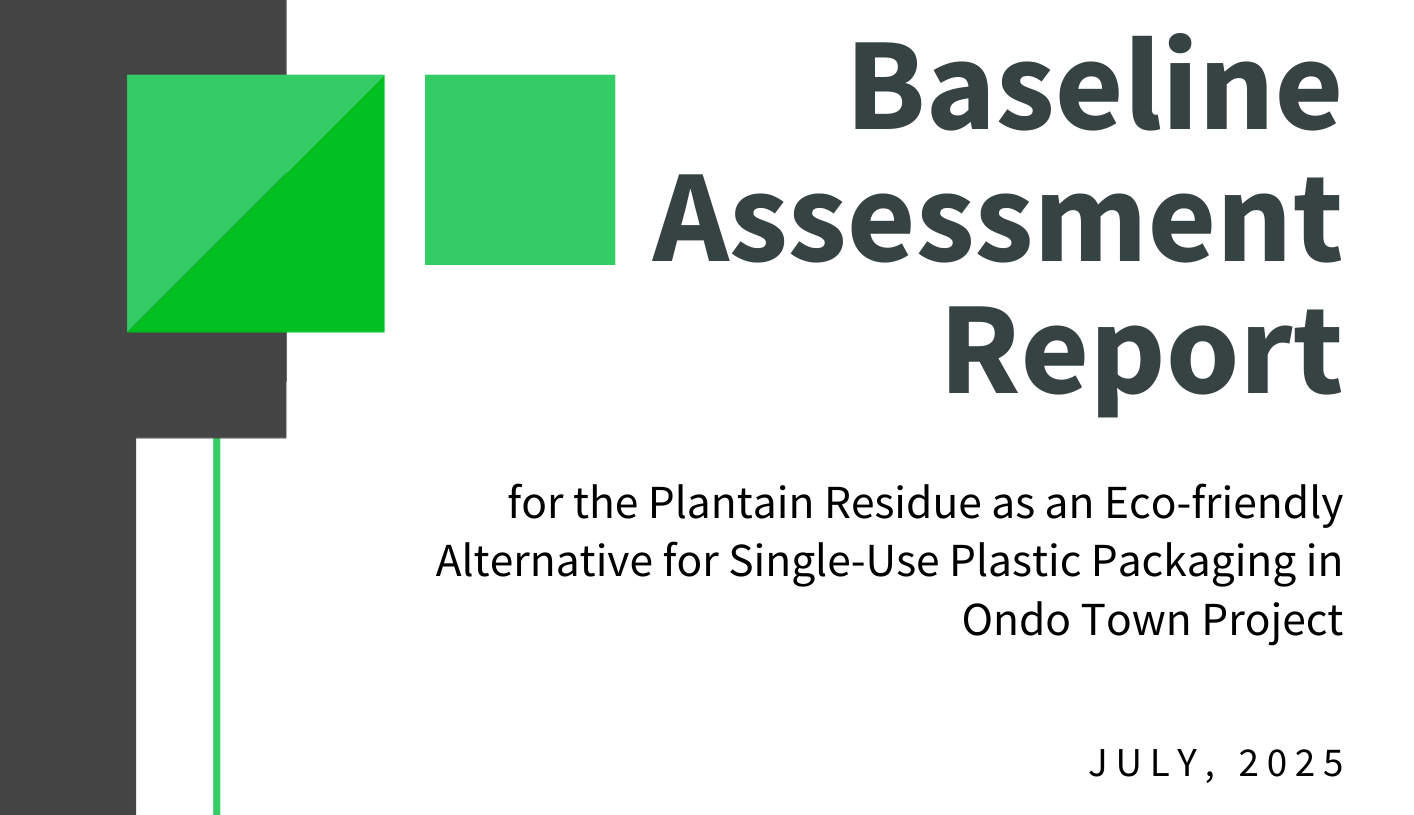
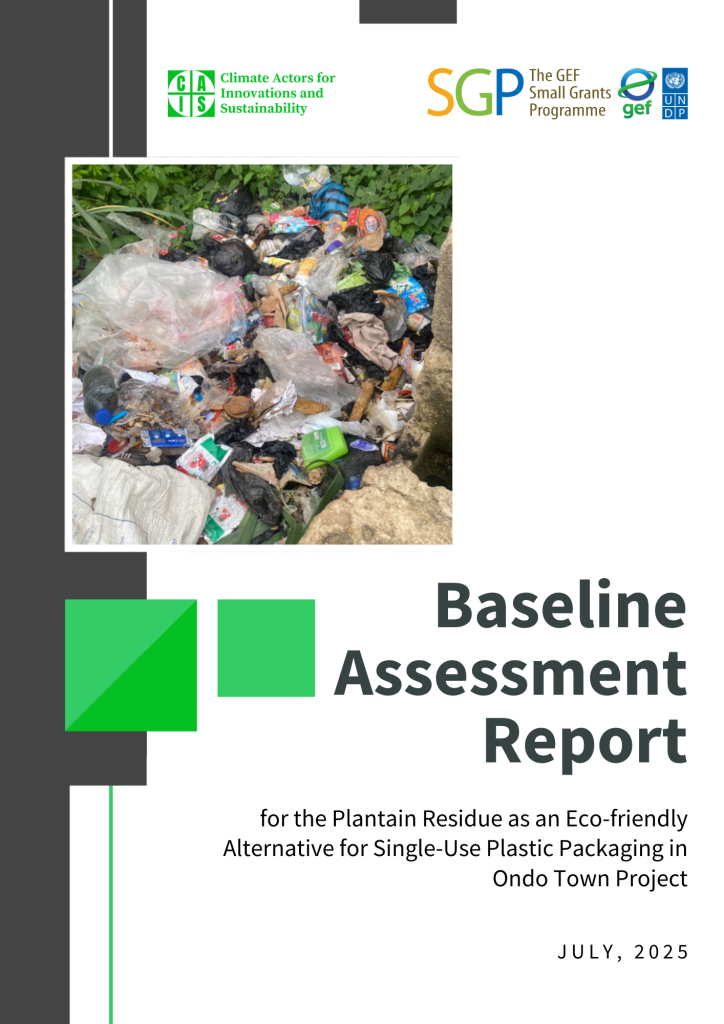
PURE-WISE Ondo Baseline Report Now Public

We are pleased to announce the public release of the Baseline Report for the Plantain Residue as an Eco-Friendly Alternative to Single-Use Plastic Packaging in Ondo Town Project. The report presents a comprehensive assessment of plastic waste management practices, environmental awareness, and climate change perceptions in Ondo Town, Ondo State, Nigeria.

The report provides a critical evidence base for understanding how plastic pollution affects urban communities and how community-led solutions can drive behaviour change, climate resilience, and green livelihoods. Conducted under the Plantain Residue as an Eco-Friendly Alternative for Single-Use Plastic Packaging in Ondo Town Project, tagged as Plastic Upcycling, Recovery, and Waste Innovation for Sustainability and Empowerment (PURE-WISE), the project was supported by the United Nations Development Programme Global Environment Facility – Small Grants Programme (UNDP GEF-SGP).

Plastic pollution remains one of the most pressing environmental challenges facing Nigerian cities. In Ondo Town, the baseline findings reveal widespread indiscriminate waste disposal, limited waste segregation, and gaps in waste collection services, conditions that contribute to flooding, public health risks, and environmental degradation.

At the same time, the report highlights significant opportunities for transformation. A strong youth presence, growing climate awareness, and expressed willingness among residents to adopt more sustainable practices provide a solid foundation for impactful intervention.

From Evidence to Action

The Baseline Report does more than document environmental challenges; it establishes clear benchmarks and actionable targets to guide effective intervention. The findings provide an evidence-based framework for designing integrated waste management responses that prioritise behaviour change communication and community engagement, youth and school-based environmental leadership, plastic recycling and upcycling, and circular economy solutions, including the productive use of agricultural residues.

More so, the report emphasises the importance of monitoring and evaluation to track environmental improvements and behavioural outcomes over time. Collectively, these strategic focus areas are aimed at reducing plastic use, improving urban environmental quality, and supporting inclusive green livelihoods within Ondo Town and similar urban contexts.

Access the Report

The Baseline Assessment Report is now publicly available and can be accessed by researchers, policymakers, development partners, and community stakeholders interested in plastic waste reduction, climate action, and sustainable urban development.

Download the report using the following link: 10.6084/m9.figshare.31216201.
Building Climate Resilience: Key Insights from Our Team Coordinator’s Radio Interview

Climate change is no longer a distant or abstract issue; it is already shaping how communities live, farm, work, and stay healthy. This was the focus of the recent episode of our radio programme, Pure-Wise Half Hour, an interview featuring Akintunde Akinmolayan, Team Coordinator at CAIS, where he spoke extensively on building resilience and adapting to climate impacts, particularly from an African and Nigerian perspective. The radio programme was sponsored by the United Nations Development Programme Global Environment Facility Small Grants Programme (UNDP GEF-SGP).

What Does Building Climate Resilience Mean?

According to Akintunde, resilience is fundamentally about responding to threats to human wellbeing. In the context of climate change, it means strengthening people, systems, and communities so that climate-related shocks—such as extreme heat, irregular rainfall, flooding, and air pollution—do not destroy lives or livelihoods.

He emphasised a critical global injustice:
Africa contributes less than 4% of global greenhouse gas emissions, with Nigeria contributing less than 1%, yet the continent bears a disproportionate share of climate impacts. From food insecurity to health challenges linked to air pollution, climate change is already affecting everyday life across African communities.

“Even though we did not cause most of this problem,” he noted, “we cannot afford to sit back and keep lamenting. We must protect ourselves.”

Adaptation: Living With Change Without Losing Dignity

A major pillar of resilience, Akintunde explained, is adaptation, the ability to adjust how we live and work so that changing climate conditions do not strip people of their dignity or means of survival.

Drawing lessons from nature, he highlighted how living organisms adapt to harsh environments, and stressed that human societies must do the same. Changing weather patterns, such as disappearing harmattan seasons and rainfall occurring at unusual times, are clear signals that old assumptions no longer hold.

Adaptation, therefore, is not optional; it is necessary for survival.

Adaptation at the Individual Level

At the individual level, Akintunde stressed the importance of daily choices. Emissions come from transportation, buildings, agriculture, bush burning, and power generation. Small actions, such as sharing transport instead of using multiple vehicles, can significantly reduce emissions.

He also highlighted the link between economic resilience and climate resilience, especially for young people. When people lack stable livelihoods, climate impacts hit harder. Being economically active strengthens the ability to cope with climate stress.

Another key message was environmental responsibility. He encouraged individuals to become “friends of nature”, particularly by protecting and planting trees. Trees play a vital role in absorbing carbon, cooling communities, and improving air quality.

Community-Based Adaptation and Economic Opportunities

At the community level, Akintunde spoke about the importance of community forests. Beyond environmental benefits, community forests now present real economic opportunities through the emerging carbon market.

Under carbon market arrangements, communities that preserve forests can receive financial compensation because those forests absorb carbon emissions generated elsewhere. Nigeria is already developing frameworks for carbon market participation, creating new pathways for communities to earn income while protecting their environment.

This approach, he noted, builds resilience by linking environmental protection directly to livelihoods.

The Role of Businesses and Indigenous Knowledge

For businesses and industries, Akintunde called for a rethink of development models. He cautioned against the assumption that foreign solutions are always best and advocated for combining indigenous knowledge with modern innovation.

“Our forefathers were already adapting to climate conditions long before we gave it a name,” he explained. Preserving indigenous methods while thoughtfully modernising them can lead to solutions that are more sustainable, culturally appropriate, and resilient.

A Call to Action

The interview concluded with a clear message: climate resilience is not only about policies and technology; it is also about choices, responsibility, and collective action. From individuals and communities to businesses and governments, everyone has a role to play in ensuring that climate change does not undermine lives, livelihoods, and future generations.